Table of Contents
Revit 2023
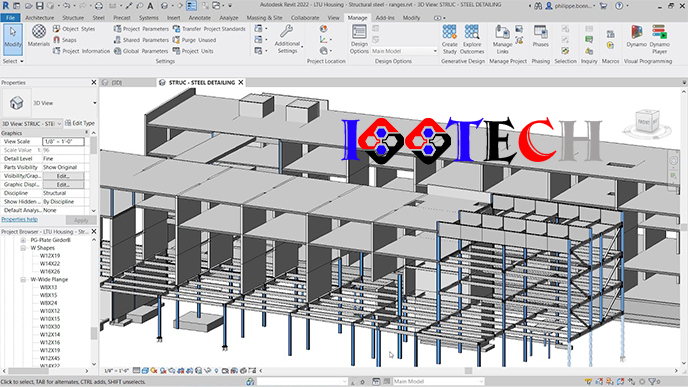
Revit 2023 is an outstanding 3D design application that allows you to design 2D as well as 3D structural models of buildings easily and quickly. Handling ventilation, circuit boards and plumbing. It provides a modern user interface that allows you to perform all operations without any complications.
Revit is the latest step in Revit’s continuous improvement and evolution for multidisciplinary BIM, an intelligent model-based process used to plan, design, construct, and manage buildings and the infrastructure. Revit supports a collaborative, multidisciplinary design workflow. Autodesk Revit software product, based on Building Information Modeling (BIM) technology, is designed to design, construct, and manage high-quality, energy-efficient buildings.
It is a full-featured solution that combines the capabilities of architectural design, engineering systems design, building structure and building modeling (Autodesk Revit Architecture, Autodesk Revit MEP and Autodesk Revit) Structure). This release marks some movement along that path. The direction map identifies forward-looking topics that guide and prioritize the development of Revit features and functionality with your input through the Revit Ideas Page.
Autodesk Revit 2023 is an all-in-one application suite that provides a complete solution for building design for architects and 3D architectural plans, and supports all elements including walls, windows, doors, roofs, floors, ceilings and more. with 4D BIM capabilities for cost estimation and project time management.
Features of Revit 2023
- Allows you to easily and quickly design 2D as well as 3D structural models of buildings.
- Provides all the tools needed to create various complex structural designs and deal with ventilation, circuit boards and plumbing.
- Provides a modern user interface that allows you to do all the operations without any complications.
- Providing a complete solution for building designs for architects and 3D architectural plans.
- Add or remove dampers or change the type of component that supports the built-in dampers.
- Use the Split Element tool and the Split with Gap tool on any straight craft.
- Supports handling of all elements including walls, windows, doors, roofs, floors, ceilings and more.
- Provides 4D BIM capabilities for cost estimation and project time management.
- Includes many settings and customizations to help you modify and adjust various parameters of the structure.
- Filter statistics table by Sheet (Filter by Sheet)
- This can be considered the most anticipated feature over the past decade. Previously, to create a schedule that only displayed objects in the drawing, users had to use complicated filtering tricks or manually split the table. With Revit 2023, a simple “Filter by Sheet” option has been added. When you place a statistical table on a drawing sheet (Sheet), the software will automatically identify and list only objects (such as doors, windows, equipment) that appear in the viewport of that drawing. This helps reduce errors and saves hours of records management time.
- Revolution in Structural Analysis Modeling (Analytical Modeling)
- For structural engineers, Revit 2023 brings a completely new way of working. Previously, the physical model (Physical Model – concrete, reinforcement) and the analytical model (Analytical Model – bars, nodes to calculate internal forces) were closely tied together. When you move the concrete column, the analysis bar also moves, making it difficult to simplify the calculation diagram.
- In version 2023, Autodesk has completely separated these two concepts. Engineers can create independent analysis models, freely drawing nodes and connecting bars without affecting the actual geometry of the building. This helps the coordination process with calculation software (such as Robot Structural Analysis) become more flexible and accurate.
- Electrical Analysis
- Previously, electrical engineers often had to wait for the architectural model to be completed before they could begin calculations. Revit 2023 introduces a preliminary electrical load analysis process right from the concept stage. Engineers can define area boundaries, assign loads per square meter, and calculate total transformer and electrical panel capacity without placing any specific electrical equipment in the model.
- Data Exchange
- Interoperability is the key to BIM. Revit 2023 enhances this capability through Data Exchange. Users can share a small portion of a Revit model’s data to the cloud (Autodesk Docs) and invite other parties to use that data in software like Microsoft Power Automate, Inventor or Rhino without sending the entire heavy Revit file.
- Control display and view on Sheet
- A small but extremely useful upgrade is the View status icon. In the Project Browser of Revit 2023, Views that have been placed on the Sheet will have a square icon highlighted in blue. This helps records managers immediately know which Views have not been included in the drawing. In addition, the “Swap View” feature allows you to replace a View on a drawing with another View while maintaining the same position and alignment, making modifying the drawing layout many times faster.
System requirements of Revit 2023
- Supported OS: Windows 7/8/10/11
- 64-bit Intel® or AMD® multi-core processor with SSE4.2 . instruction set
- Memory (RAM): 8 GB Recommended: 16 GB
- Hard disk space: 9 GB of free disk space for installation
Revit 2023 Free Download
Autodesk Revit 2023 (x64) Multilingual
Autodesk Collection